By 2026 the four AI coding tools developers compare most (Cursor, Claude Code, GitHub Copilot, and OpenAI Codex) have all moved toward metered usage instead of flat “unlimited” access. GitHub Copilot is the latest: it switches to usage-based billing on June 1, 2026, the same shift that triggered a refund cycle for Cursor a year earlier. The practical question is no longer “which tool is best” but “which usage system am I actually paying for, what burns through it, and how do I avoid a surprise bill.”
This guide pulls the current pricing and limit structures into one place from official documentation and developer reports, decodes what consumes your quota, and gives a plan-fit framework. Numbers reflect May 2026 and are anchored to their sources; pricing in this category changes monthly, and Copilot’s June 1 change will move several of them.
Why This Guide Exists
Most existing comparisons rank these tools on benchmarks and feature breadth. Almost none explain the part that actually generates frustration: the billing mechanics. Developers report hitting limits at low reported usage, watching a $20 plan turn into a $500 month, and getting locked out mid-project with no clear reset time. Those are not feature problems. They are metering problems, and they are now common to the whole category.
The 2026 Shift: From “Unlimited” to Metered
The pattern repeats across vendors. Cursor moved from request-based caps to usage-based billing in June 2025, and the rollout was poorly communicated enough that the company apologized and issued refunds for surprise charges. OpenAI moved Codex credits to token-based pricing on April 2, 2026. GitHub follows on June 1, 2026, shifting Copilot from request-based to usage-based billing.
There is a structural reason coding tools keep hitting this wall while AI marketing or support tools do not. Coding work cannot be scoped in advance. Sometimes you open the editor for a ten-minute fix, sometimes for a five-hour build. Any usage cap collides directly with the developer’s need to stay in flow. When the meter and the workflow disagree, the meter wins, and the user feels it as a broken tool rather than a pricing change.
Treat any “unlimited” label in this category as conditional. The real number is what you pay in a heavy month, not the headline tier price.
The Four Pricing Models Side by Side
| Tool | Entry paid tier | Higher tiers | Billing model | What “real” daily-agent use costs |
|---|---|---|---|---|
| GitHub Copilot | Pro $10/mo | Pro+ $39/mo, Business $19/seat, Enterprise $39/seat | Request-based → usage-based June 1, 2026 (GitHub AI Credits, token-based) | $10 entry; agentic use higher once metered |
| Claude Code | via Claude Pro $20/mo | Max 5x $100/mo, Max 20x $200/mo, or API pay-as-you-go | Shared plan budget (chat + code), overage at API rates | Heavy daily users typically need Max 5x ($100) |
| Cursor | Pro $20/mo | Pro+ $60/mo (3x), Ultra $200/mo (20x), Teams $40/seat | Usage credits ($20 model credit pool on Pro) | Cursor’s own docs say $60–100/mo for daily Agent users |
| OpenAI Codex | via ChatGPT Plus | Pro, Business, Enterprise/Edu | Token-based credits since April 2, 2026 | Varies by token consumption |
Two facts the headline prices hide. First, Claude Code is not priced as a standalone product. It runs through your Claude plan or API account and draws from the same usage budget as Claude chat, so both tools share one bucket. Second, Cursor’s $20 Pro tier includes a $20 model-credit pool; heavy agent loops draw from it at API-equivalent rates, which is why daily users routinely land well above the sticker price.
GitHub’s April 20, 2026 guidance also paused new signups for Copilot Pro, Pro+, and Student plans and tightened individual usage limits. Verify current availability directly before relying on a specific tier.
What Actually Burns Your Quota
The most confusing complaint in this category is hitting a wall while the dashboard still shows low usage. The cause is that these tools run several independent limit systems at once: per-minute request and token rates plus rolling-window and weekly quotas. The percentage you see usually reflects only one of them, so you can read low on one meter and be blocked by another.
Claude Code makes the layering visible. Its usage panel shows a session meter and a weekly meter side by side, each on its own reset clock. You can sit at 40% for the week while a 77% session meter is the thing actually stopping you.
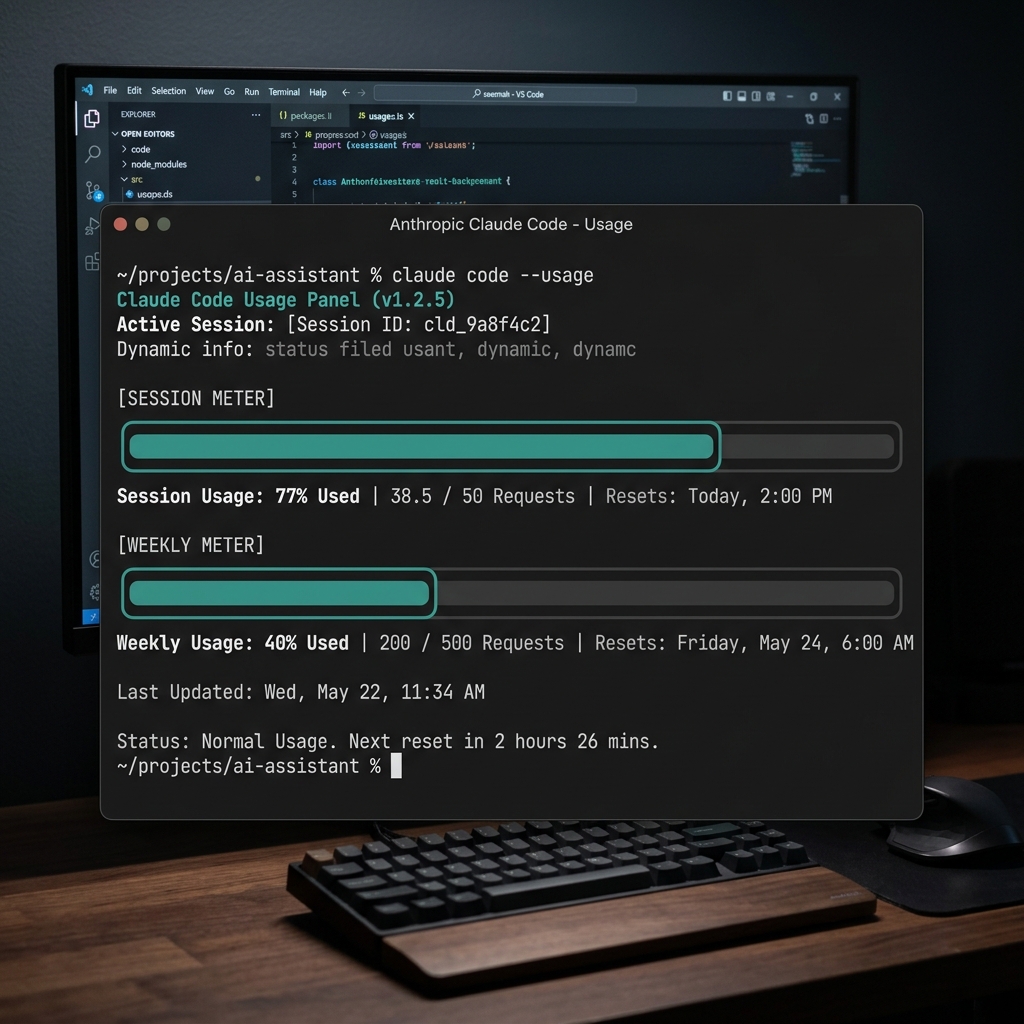 Claude Code’s usage panel: two independent limits, two reset clocks.
Beyond that, four things consume usage faster than people expect:
- Agent loops. Autonomous multi-file edits call the model repeatedly. One "fix this feature" prompt can fan out into dozens of model calls.
- Context size. Larger codebases and longer contexts cost more per call. A request that touches 30 files is not the same unit as a one-line completion.
- Long single threads. Keeping one chat or session running for dozens of turns forces the model to re-read the whole history every reply, which burns the budget far faster than starting fresh.
- Shared budgets. On Claude plans, chat and Claude Code draw from the same allowance, so a heavy research session in chat leaves less for coding.
None of these show up as a line item. They show up as a limit you hit sooner than the tier price led you to expect.
Tool-by-Tool Reality
Claude Code. Billed through your Claude plan, with usage shared across chat and code. When you hit the limit you either wait for the reset or switch to usage credits billed at standard API rates. Heavy daily users generally need Max 5x ($100/mo) to avoid hitting Pro-tier limits mid-session. API-only billing tends to run higher for sustained professional workloads, so the flat Max subscription is often cheaper at consistent daily volume. (A dedicated deep-dive on Claude Code’s limit behavior is available in our guide on Claude Code usage limits.)
Cursor. Pro includes a $20 model-credit pool. Cursor’s Auto mode routes to a cost-efficient model and does not draw from that pool, while manually selecting premium models bills at API-equivalent rates. This is the single biggest lever on a Cursor bill: lean on Auto for routine work, reserve manual premium-model selection for tasks that need it.
GitHub Copilot. The cheapest entry point at $10/mo, and its free tier is the most usable of the four, but the June 1, 2026 move to usage-based billing changes the math. The base subscription price does not rise. Instead each plan gets a monthly allotment of GitHub AI Credits (1 credit = $0.01), and usage is charged on token consumption (input, output, cached) at each model’s listed API rate. Code completions and Next Edit Suggestions stay free; agentic sessions burn credits fastest. Monthly Pro and Pro+ plans auto-migrate on June 1; annual plans are being retired. After June 1, expect the same "what am I actually consuming" questions Cursor users have been asking for a year.
OpenAI Codex. Bundled with ChatGPT plans rather than sold separately, with credits now token-based as of April 2026. Cost tracks token consumption, which makes it cheap for isolated, fire-and-forget tasks and harder to predict for sustained work.
How to Avoid a Surprise Bill
The defensive moves are consistent across tools:
- Start fresh sessions. Don’t let one thread run for 50 messages. A new, tighter session burns far slower than a resumed long one.
- Use cost-efficient routing. On Cursor, prefer Auto mode for routine completions; it doesn’t draw your credit pool. Reserve premium models for genuinely hard tasks.
- Decline overage if you want a hard ceiling. On Claude plans, the usage-credit option continues your work at API rates after you hit the limit. Decline it to stay strictly inside your subscription budget.
- Match the plan to your real pattern, not the sticker. If you run agents daily, price against the real monthly cost ($60–100 on Cursor, Max 5x on Claude Code), not the entry tier.
- Mind peak hours. Some tools tighten behavior during high-demand windows, so the same task can cost more at 11am than at 6am.
Which Plan for Whom
| Profile | Best fit | Why |
|---|---|---|
| Budget-conscious solo dev | Copilot Pro ($10) | Cheapest entry and usable free tier; re-check after June 1 |
| AI-first IDE user | Cursor Pro ($20), lean on Auto | Best in-editor experience; control cost via Auto routing |
| Heavy daily agent user | Claude Code via Max 5x ($100) | Flat rate beats API billing at consistent volume |
| Bursty / automation workloads | API pay-as-you-go or Codex | Token billing fits variable, fire-and-forget use |
| Enterprise / compliance | Copilot Enterprise | Most mature SSO, audit, and policy controls |
The widely reported 2026 pattern among professional developers is to combine tools rather than pick one — an in-editor assistant for daily work plus a terminal agent for deep tasks — and to treat the combined cost as a metered compute budget rather than a fixed seat fee.
FAQ
Why do I hit my limit when the dashboard shows low usage?
Because these tools run several independent meters at once (per-minute rate, rolling-window, weekly), and the percentage shown usually reflects only one of them. You can be low on one and blocked by another.
Is Claude Code billed separately from Claude chat?
No. On Pro and Max plans, usage is shared across Claude chat and Claude Code — both draw from the same budget, per Anthropic’s documentation.
What changes for GitHub Copilot on June 1, 2026?
Copilot moves from counting premium requests to usage-based billing. Each plan includes a monthly allotment of GitHub AI Credits (1 credit = $0.01), and usage is charged on token consumption at each model’s listed API rate. Base subscription prices do not rise, and code completions stay free, but agentic sessions consume credits fastest.
Why did Cursor users get surprise bills?
Cursor moved from request caps to a usage-credit model in 2025; agent loops and premium-model selection draw credits at API-equivalent rates, so heavy use ran far above the $20 sticker. Cursor apologized and refunded some charges.
Does API billing ever beat a subscription?
For consistent daily use, the flat Max or Pro subscription usually wins. API pay-as-you-go fits variable or automation workloads. As a rough rule, API only beats Pro below roughly 50 sessions a month.
How do I keep a hard cost ceiling on Claude plans?
Decline the usage-credit (API overage) option when prompted. That keeps you strictly inside your subscription allowance; you wait for the reset instead of paying overage.
Which is cheapest overall?
Copilot Pro at $10/mo is the cheapest entry today. But "cheapest entry" and "cheapest at heavy daily use" are different questions: agent-heavy workflows can make a flat $100 Max plan more predictable than metered alternatives.
Updates & Changelog
- 2026-05-21 — Initial publication. Pricing verified against official sources for May 2026, including GitHub’s June 1, 2026 usage-based billing announcement and Anthropic’s plan documentation. Copilot’s per-model token rates take effect June 1; re-verify exact rates after the switch.
Pricing and limits in this category change frequently. Figures are anchored to May 2026 sources; verify against each vendor’s official documentation before purchasing.